Free QR code ordering for small food businesses: what you actually get
· 9 min read · The Yernex team
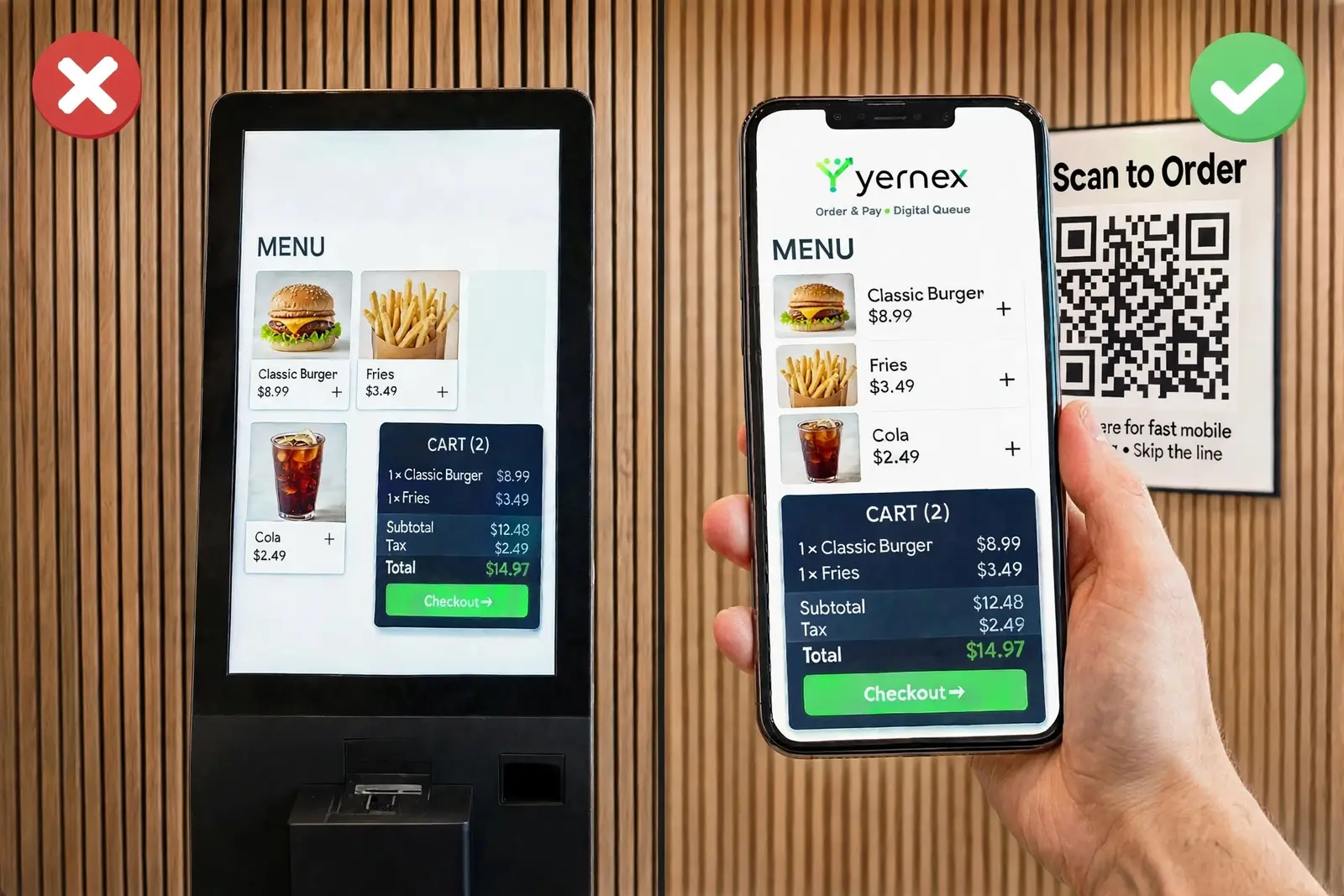
Search for a free QR code ordering system and you will find dozens of them. Most really are free to start. The question is what "free" covers once a customer has scanned the code, ordered and paid, and who ends up paying for it: you, your customer, or nobody. This post covers what free QR ordering usually includes, the three ways it gets paid for, how the big restaurant platforms charge for theirs, and how Yernex keeps QR code ordering free for shops on Square.
What a free QR code ordering system usually includes
A QR code on its own costs nothing. Any free generator will make one. What you are really choosing is what happens after the scan, and "QR code ordering" can mean three quite different things:
- A menu you can read. The code opens a PDF or a web page. Customers still order at the counter. Many "free QR code menu" tools stop here.
- A menu you can order from. Customers pick items on their phone and send the order to you, but pay at the counter or on collection.
- Order and pay on the phone. Customers order, pay by card, Apple Pay or Google Pay, and the order arrives already paid. This is what most people mean by a QR code ordering system, and it is the version that actually takes the line off your counter.
The third kind has real costs behind it: card payments, a menu that has to match your till, and somewhere for the order to land in your kitchen. So when a QR code ordering system is free, it is worth asking how that cost is covered.
The three ways "free" QR ordering gets paid for
1. A fee on every order
Some platforms add a small fee to each order, and either you or your customer pays it. me&u, which merged with Mr Yum, publishes its Australian platform fee in its help centre: from 20 cents on an order under $25, rising in steps to $2.90 on orders of $150 and over. On its older platform, the fee is 2.2% of the order total instead. Some venues absorb the fee and some pass it on, where it shows as its own line at checkout.
A fee on each order keeps the upfront price at zero. If your shop pays it, it adds up over a busy weekend. If your customer pays it, it should be small and shown clearly before they pay.
Yernex works this way too, and we would rather say so up front: your customers pay a 10c convenience fee on each QR order, and your shop pays nothing to Yernex.
2. Card processing
Every order paid by phone carries a card processing fee, just as a tap at your register does. This is the one cost no QR ordering system can remove. What you can check is whose rate applies (your existing payment provider's, or a new one the QR platform sets) and whether online payments are charged at a different rate from taps at the counter.
3. A monthly plan or a paid add-on
Here the QR ordering itself is part of a subscription. Square Online gives every site a QR code for ordering ahead, but its Australian QR code ordering page says ordering by QR code for in-person dining needs a paid Plus or Premium plan. Lightspeed sells Order Anywhere as an add-on to Lightspeed Restaurant, with pricing on request, and Toast doesn't publish a price for Mobile Order & Pay either.
What the big restaurant platforms do well
Toast, Lightspeed and me&u are built for full-service restaurants, and for those they do a lot. Toast's own support pages describe guests ordering throughout a meal on one open tab and splitting the bill at the end. Lightspeed describes Order Anywhere as serving guests through QR codes, online ordering platforms and the venue's own ordering website. If you run table service with a bar tab culture, those features matter, and a pickup-first tool won't replace them.
They also come with their own point-of-sale system, or work best with one. QR ordering from Toast or Lightspeed assumes you run Toast or Lightspeed at the register. If you already do, start by asking your provider what their QR ordering costs on your plan.
One more thing worth knowing about "free" costs: they can change. In July 2023, Toast added a 99-cent fee to online orders of $10 or more and dropped it within about two weeks after restaurants pushed back. It is a good reason to ask any provider who decides the fees, and whether you can see them before your customers do.
What happens after the customer pays
This is the part most free QR menus skip. The customer has paid. Now what?
At a food truck window or a café counter, the order has to reach the person cooking, get a number, and get back to the customer when it's ready. If it lands on a separate tablet nobody is watching, you have swapped a line at the register for a crowd at the pickup window asking "is mine done yet?"
So when you compare free QR code ordering systems, look past the menu and ask:
- Where does the order land? In the same queue as your register orders, or on a second screen?
- Does it get a ticket number from the same sequence as everything else?
- How does the customer find out it's ready? Calling names over the noise is what you were trying to get away from.
- What happens when you sell out? Can you pull an item off the menu mid-service, in one tap?
Free QR code ordering on Square: nothing for your shop, 10c for your customer
If you already take payments with Square, Yernex's Square QR code ordering works with your existing account and register. It is included on every plan, including Free:
- Your Square menu. Yernex reads your items, options and prices from Square and keeps them in sync, so there is nothing to set up twice.
- Customers order and pay on their phone by card, Apple Pay or Google Pay, through your own Square account. The sale shows in your Square reports like any other, and Square's usual processing fees apply.
- A 10c convenience fee, paid by the customer. It shows as its own line in their bag before they pay. It is how Yernex keeps QR ordering free for your shop: you pay no fee to Yernex per order. Orders at your register have no fee.
- One queue. Paid QR orders, register sales and tickets your team adds all land on the same Service Board, numbered from the same sequence.
- The current wait, before they order. The menu shows the current wait and how many orders are ahead.
- An upsell on every order. Before paying, customers see "Anything else with that?" and what is "Popular with your order", one tap to add.
- Sold out in one tap. Mark an item sold out from your dashboard and it leaves the menu at once. It comes back on its own within 12 hours.
- The phone tells them it's ready. Customers follow the order on their own phone, no app needed, and it plays a sound when you tap Ready. On iPhone, "Notify me" alerts need the page added to the Home Screen first, and Yernex shows them how. It's the same tracking as our phone-based buzzer system.
The Free plan has no time limit and no card to enter, with up to 10 tickets in progress at a time. Pro removes that limit and adds your own branding on the ordering page, an "Order again" button on the tracker and the Now Serving screen. What it costs is on the pricing page.
Where Yernex isn't the right fit
To be straight about the limits:
- Square only. Yernex's QR ordering connects to Square and no other point of sale today. If you run Toast or Lightspeed, use their QR ordering. Without Square you can still run the queue and mobile order tracking (and the Now Serving board on Pro), just not QR ordering.
- Built for pickup, not table service. Customers can scan and order at a table, but Yernex doesn't yet tell your team which table to take it to, and there are no open tabs or split bills. A full-service restaurant is better served by its POS provider's table ordering.
- Some people want to order from a person. Keep the register open. QR orders and register orders share one queue and one numbering.
- It needs mobile signal. If your spot has none, phones can't order or be told the food is ready.
Questions to ask before you choose
Whichever free QR code ordering system you look at, these five questions show what free really means:
- Is there a fee on each order, and who pays it, you or your customer?
- Whose card processing rate applies?
- Which features need a paid plan or an add-on?
- Does it work with the register you already have, or ask you to switch?
- Where does the order land, and how does the customer find out it's ready?
So which should you choose?
On Toast or Lightspeed, start with their own QR ordering and ask for the price on your plan. For table service with tabs and split bills, a full restaurant platform will do more. If you run a food truck, café or takeaway counter on Square and want QR code ordering that costs your shop nothing, with the order landing in your queue and the customer's phone telling them it's ready, Yernex does that on its free plan, for a 10c fee your customer pays.
Not sure which setup fits your counter? The setup finder asks a few questions and tells you. Or start free and print your first QR code before the next rush.
Frequently asked questions
Is there a free QR code ordering system?
Yes. Several have free plans, but most cover their costs with a fee on each order, a paid plan for key features, or card processing. Yernex's QR ordering costs shops on Square nothing on every plan: customers pay a 10c convenience fee on each QR order, and the shop pays only Square's usual card processing fees.
Is QR code menu ordering free with Square?
Square Online gives every site a QR code for ordering ahead, but its Australian QR code page says ordering by QR code for in-person dining needs a paid Plus or Premium plan. Yernex adds QR ordering to your existing Square account on its free plan, with a 10c convenience fee paid by your customer.
Do customers pay a fee to order by QR code?
It depends on the platform and the venue. me&u, for example, charges a platform fee on each order in Australia that some venues absorb and some pass on. With Yernex, customers pay a 10c convenience fee on each QR order, shown as its own line before they pay.
Do customers need to download an app?
No, not with Yernex. Customers scan the code with their phone camera and the menu opens in the browser, then the same page tracks their order until it's ready.
Does Yernex QR ordering work with Toast or Lightspeed?
No. Square is the only point of sale Yernex connects to today. If you run Toast or Lightspeed, their own QR ordering is the place to start.
Can I use QR code ordering for table service?
Customers can scan and order from their table, but Yernex is built for pickup: it tells customers when to collect and doesn't yet tell your team which table to bring it to. For full table service with tabs and split bills, a restaurant platform's table ordering is a better fit.
Prices, plans and features mentioned in this post were correct at the time of writing and may change without notice. The pricing page always shows what is current.
More from the blog