How far do restaurant buzzers reach? (And the one with no range limit)
· 6 min read · The Yernex team
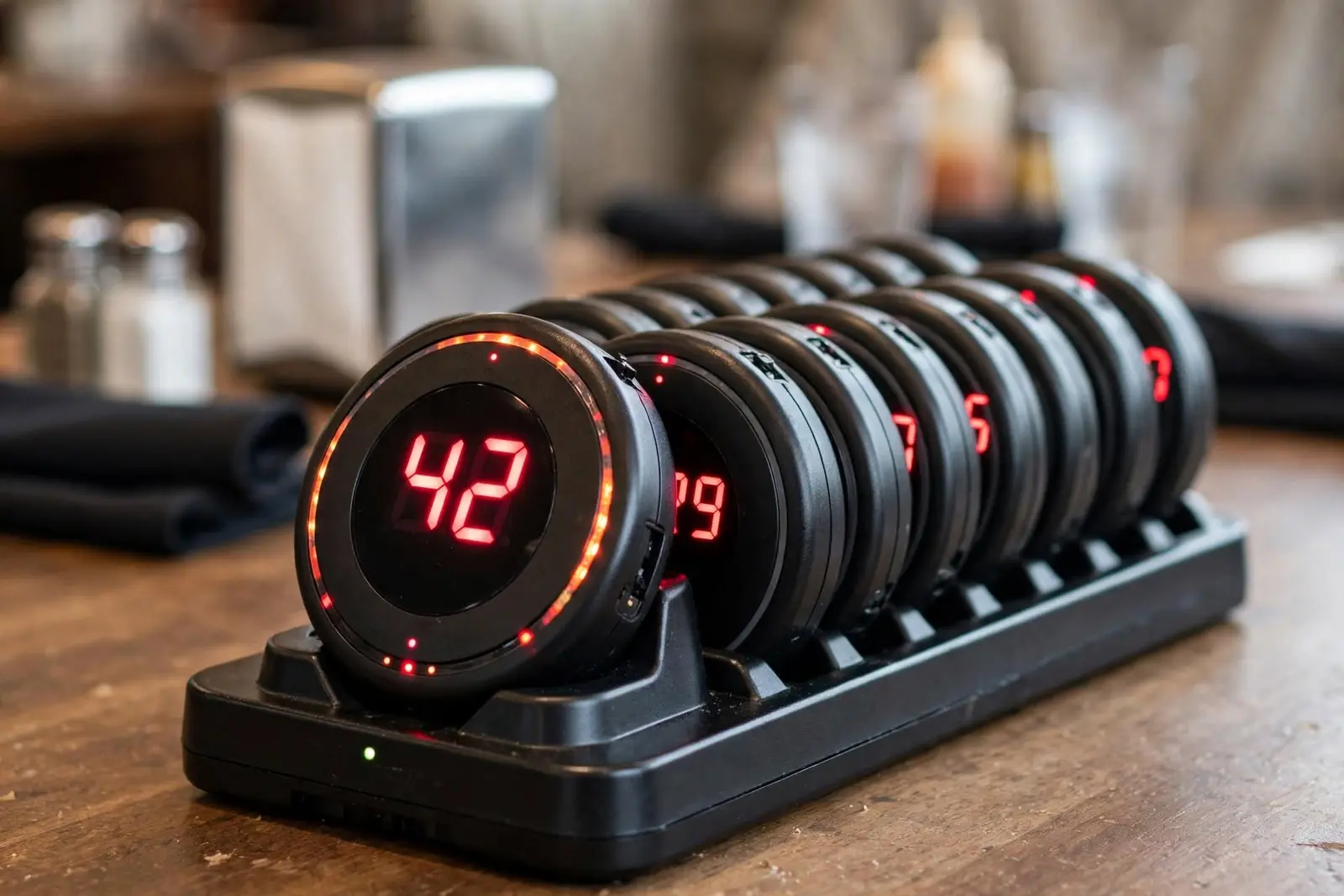
If you have ever watched a customer walk out to their car with your buzzer in their hand, you already know the question this post answers: what is the real restaurant buzzer range, and what happens when someone goes past it?
The honest answer is "less than the box says, and nothing at all". Here is why, how to get the most out of the pagers you already own, and what to use when your customers want to go further than any transmitter reaches.
The short answer
Most coaster pager systems are sold on an open-area range of a few hundred metres up to about a kilometre. Two examples from one well-known brand: Retekess advertises its TD103 coaster pager system at 1,000 metres (3,280 ft), and its TD156 at 2,624 ft.
Those are open-area figures: transmitter and pager in clear line of sight, nothing in between. Your shop is not an open area. Expect a good deal less once there are walls, people, fridges and a kitchen between the base and the pager.
Why the range on the box isn’t the range in your shop
A restaurant pager is a small radio. Anything that absorbs or reflects radio signals shortens how far it reaches:
- Walls and floors. Every wall the signal passes through costs range. Brick and concrete cost more than plasterboard. Upstairs seating is a common dead spot.
- Metal. Steel benches, coolrooms, shelving and metal roofs reflect the signal. A food truck is a metal box, so a transmitter tucked inside it starts at a disadvantage.
- Kitchen equipment. Busy commercial kitchens are full of motors and electronics, and manufacturers warn that some of them can interfere with paging signals.
- Where the base sits. A transmitter on a low shelf behind the counter, or on a metal surface, reaches less far than the same one mounted high and in the open.
- Battery. A pager that has not been charged properly may not buzz loudly enough to notice, even when the signal arrives.
None of this means buzzers do not work. Inside a single dining room they usually do. The trouble starts at the edges: the outdoor tables, the car park, the next stall over at a market.
How much range do you actually need?
Picture where your customers really go while they wait:
- Inside, in sight of the counter. Almost any system covers this. Many customers would hear you call the number anyway.
- Outdoor seating or a second room. Within range for most systems, but walls and doors start to matter. Test it.
- A food court, market or festival. Customers wander off to find a seat, grab a drink or watch the band. Distance plus crowds plus other stalls’ equipment is where pagers start to miss.
- The car park or the shop next door. Often past the edge, and the place customers most want to wait.
If most of your customers stay in the first two groups, a buzzer system can do the job. If you serve the last two, range will be a daily problem.
How to get the most range from the buzzers you already have
Before you replace anything, try these:
- Mount the transmitter high and in the open, away from metal and away from the coffee machine and fridges.
- Walk the edges. Take a pager to your furthest table, the car park and the footpath, and send it a test page from the base. You will find your real range in five minutes.
- Tell customers the boundary. “It works anywhere in the dining room and the courtyard” prevents most lost-signal complaints.
- Charge every pager fully at the end of each day, so a weak battery is not mistaken for a range problem.
- Ask your supplier about extending range. Some systems offer stronger transmitters or repeaters. Check what yours supports before buying a new set.
What happens at the edge of the range
This is the part that hurts. When a pager is out of range, nothing happens. The base sends the page, the pager never hears it, and neither you nor your customer finds out.
So the food sits on the pass going cold. The customer, sitting happily outside, wonders why it is taking so long. Eventually they come back to the counter to ask, which is exactly what the buzzer was meant to save you.
There is a second problem that range doesn’t cause but makes worse: a buzzer only knows one thing. It can’t tell anyone how long is left or how many orders are ahead, so even within range, people hover near the counter just in case.
The buzzer with no range limit: your customer’s phone
Nearly everyone in your line is already holding a device that can receive a message from anywhere it has signal. That is the idea behind Yernex: instead of handing over a buzzer, you show the customer a QR code. They scan it with their phone camera, and their order opens in the browser. No app, no account.
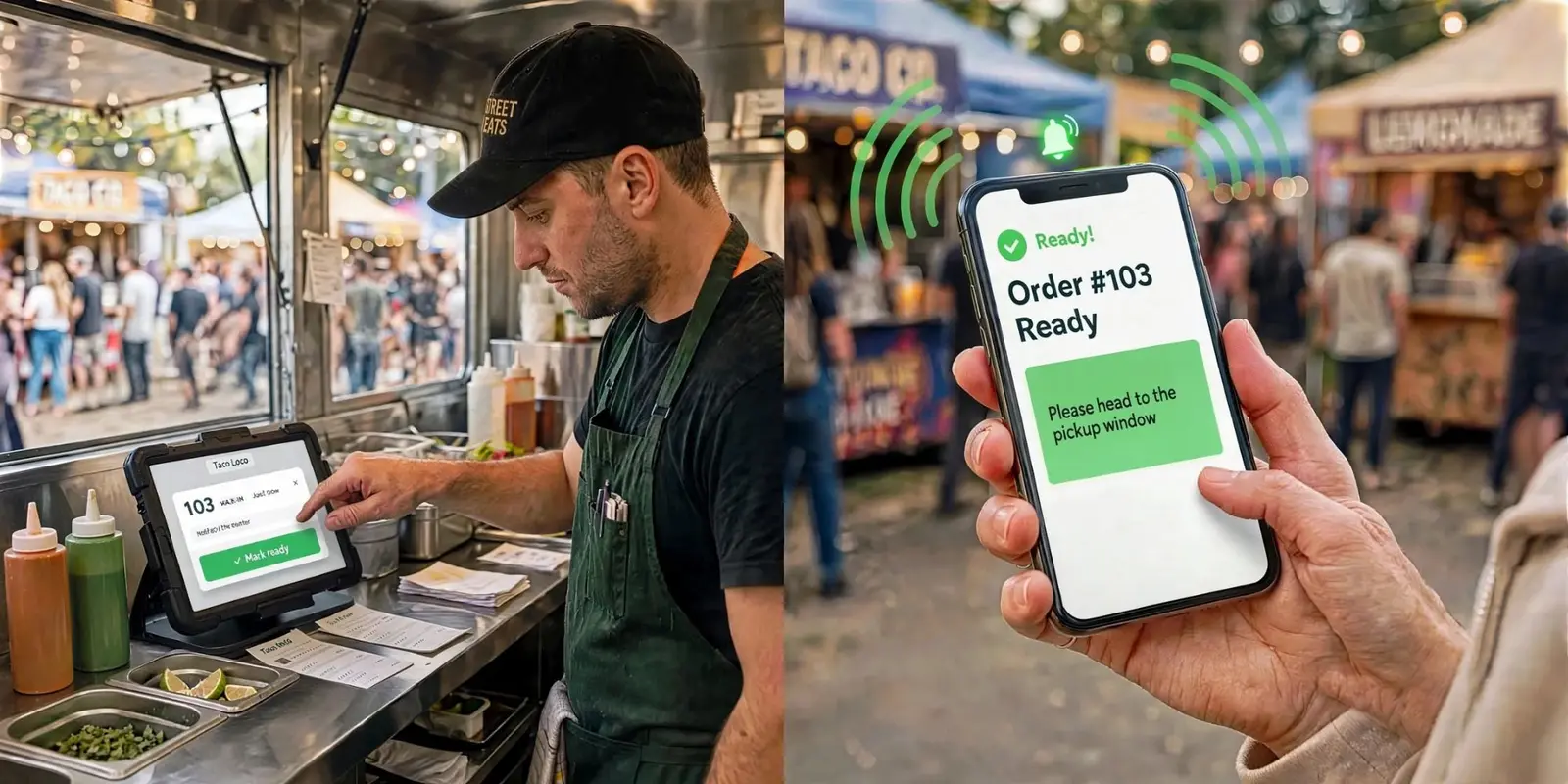
From then on:
- Their phone shows the order moving through your stages, and how many orders are ahead of theirs.
- When you tap Ready, their phone plays a sound and tells them where to collect.
- If they tap “Notify me”, they get a notification even after switching to another app. On iPhone, they add the page to their Home Screen first, and Yernex shows them how.
- A Now Serving screen on any TV or tablet you already own shows the numbers too, for anyone without a smartphone.
The range is wherever their phone has mobile signal or Wi-Fi. That covers the car park, the next stall and the band at the other end of the market. There is nothing to charge, clean, replace or chase down at closing time.
To be fair to buzzers, there is one place they still win: a buzzer needs no mobile signal. If your spot has none, a Now Serving screen at the counter covers the customers whose phones cannot connect, and you can call numbers out as you do today. Many counters keep a few buzzers for exactly that, and run both side by side.
If you run a food truck, the food truck page shows how this looks at a busy window. If you want to see how it fits your current setup, the setup finder asks a few questions and tells you. Yernex has a free plan with no time limit, so you can try it at your next service before deciding anything.
Frequently asked questions
What is the range of a restaurant pager?
Manufacturers usually quote an open-area range of a few hundred metres to about a kilometre. Inside a real restaurant, walls, metal and kitchen equipment shorten it, so walk your space with a test pager to find your actual range.
Do restaurant buzzers work through walls?
Yes, but every wall costs range, and brick, concrete and metal cost the most. A second dining room usually works; upstairs seating or a room behind a coolroom may not.
Why do restaurant buzzers stop working outside?
Usually because the customer has gone past the edge of the range. When that happens, the pager simply never receives the page, and nobody is told it failed.
Can I extend the range of my restaurant pagers?
Start with placement: mount the transmitter high, in the open and away from metal. Some systems also offer stronger transmitters or repeaters, so ask your supplier what yours supports.
Do restaurant buzzers work in a food truck?
They can, but a food truck is a metal box, which shortens the range. Keep the transmitter near the serving window and test how far customers can go before pages stop arriving.
Is there a restaurant pager with no range limit?
Your customer’s phone. With Yernex, customers scan a QR code and their phone tells them when the order is ready, anywhere it has signal, with no hardware to buy.
Prices, plans and features mentioned in this post were correct at the time of writing and may change without notice. The pricing page always shows what is current.
More from the blog